New AI agents can think in hidden code but still talk through text
Researchers show that letting LLM agents switch between internal latent reasoning and public text can cut costs by over half and speed up work.
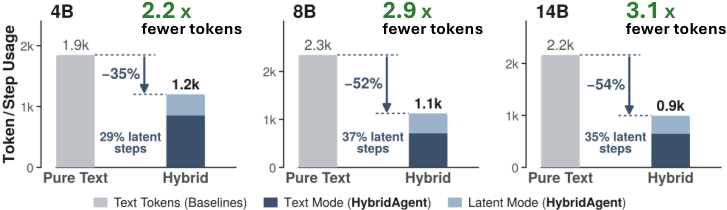
A new kind of AI agent
HybridReasoningAgents researchers recently showed that large language model agents don't have to choose between thinking privately in hidden representations or acting publicly through text.
Modern AI agents typically work one way: they process information, plan steps, and call tools by generating text at every stage. This makes their reasoning visible and transparent, but it can be slow and expensive. On the other side, some recent work has shown that giving AI systems a separate internal reasoning space, often called latent reasoning, can make computation faster and use fewer tokens. The problem has been that those private-thinking systems struggle to access external tools like search engines or calculators.
Jiaru Zou, a researcher at Stanford University, and co-authors argued that both approaches have value and set out to combine them. Their system, called HybridAgent, lets the model switch dynamically between a private internal mode and a text-based interaction mode during a single generation process.
How the switching works
The key architectural piece is something the paper calls HybridLink, a lightweight component that routes information between the two modes. When the agent needs to perform complex calculation or planning, it can enter a latent reasoning mode where it processes information in a compressed, internal format. When it needs to call a tool, respond to a user, or interact with the outside world, it switches back to text generation.
The system also keeps a continuous working memory that preserves the full hybrid context across multiple conversation turns. Unlike systems that lose information when switching modes, this design maintains lossless context so the agent does not forget what it was doing.
Training methods
The researchers developed dedicated post-training algorithms to make the hybrid system work well. The first step, called HybridSFT, teaches the model how to coordinate with the HybridLink component and how to produce tool-integrated hybrid output sequences during supervised fine-tuning.
The second step, called HybridRL, scales reasoning capability by letting the model learn through reinforcement learning when it should stay in latent mode and when it should switch to text mode for acting.
Results
The paper reports tests across 11 benchmarks covering mathematics, science, medicine, web search, and agentic planning tasks, evaluated at three different model sizes.
According to the study, HybridAgent improved performance by roughly 10.4 percent compared with existing frontier LLM agents and agentic frameworks that rely solely on text-based or latent-only reasoning. The hybrid approach also cut token usage by between 35.5 and 54.7 percent, delivered inference speeds 1.8 to 2.6 times faster, and reduced costs by 2.7 to 3.7 times. The researchers made their code and data publicly available on GitHub.
This work suggests that the most practical path forward for capable AI agents may involve combining private, efficient internal computation with public, transparent text interaction rather than forcing a choice between the two.
arXiv:2610.18861
Key facts
- HybridAgent combines private internal reasoning with public text interaction in a single system.
- A lightweight HybridLink component enables seamless switching between modes.
- Training uses HybridSFT for coordination and HybridRL for scaling reasoning decisions.
- Tests across 11 benchmarks showed about 10.4 percent accuracy gains with 35.5 to 54.7 percent fewer tokens and up to 3.7 times lower cost.
- The research was submitted to arXiv in October 2026 by Jiaru Zou and co-authors.
Hybrid Reasoning Agents | arXiv:2610.18861 | GitHub: HybridAgents
Key facts
- HybridAgent combines private internal reasoning with public text interaction in one system
- A lightweight HybridLink component enables seamless switching between modes
- Training uses HybridSFT for coordination and HybridRL for scaling reasoning decisions
- Tests across 11 benchmarks showed about 10.4% accuracy gains with 35.5-54.7% fewer tokens and up to 3.7x lower cost
- The research was submitted to arXiv in October 2026 by Jiaru Zou and co-authors
Sources
- Hybrid Reasoning Agents
- World model (artificial intelligence) — en.wikipedia.org
Watch
Related stories
 How it worksHow Google's RRSI lets AI agents improve themselves without going off the railsHerald of AI
How Google's RRSI lets AI agents improve themselves without going off the rails
A new Google Research guide shows how self-improving agents can rewrite their own code using regularized feedback loops.